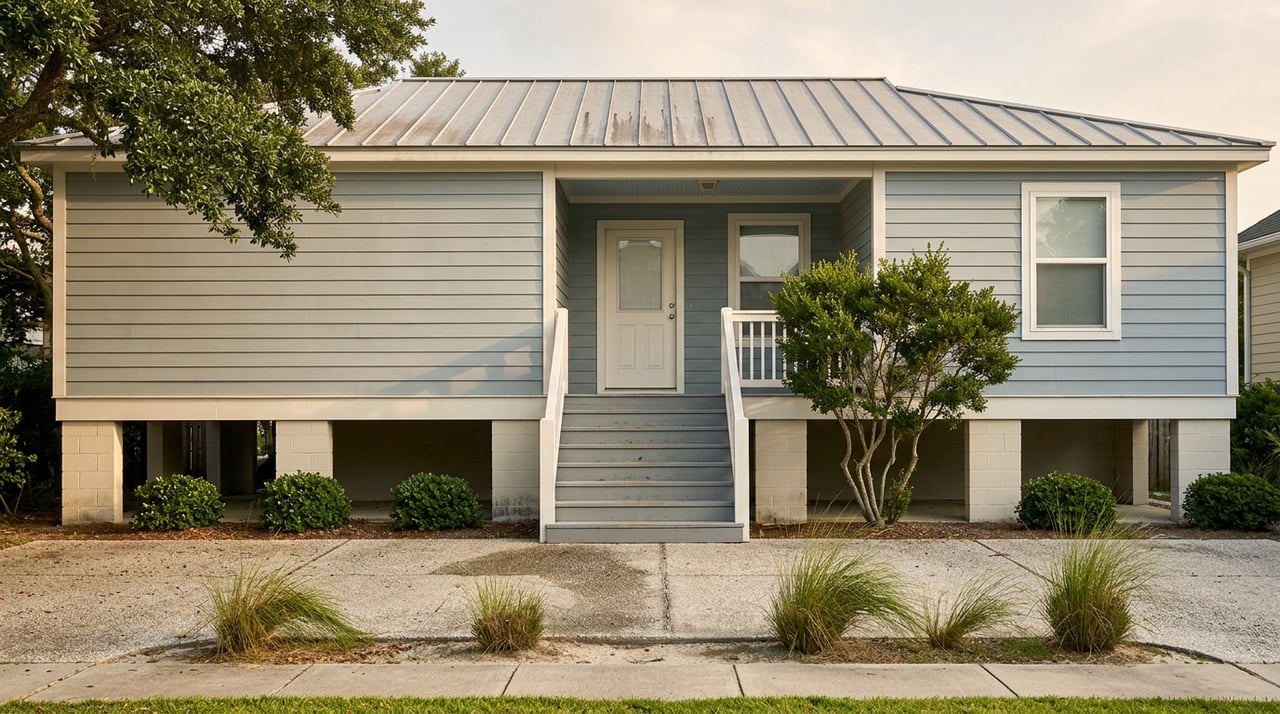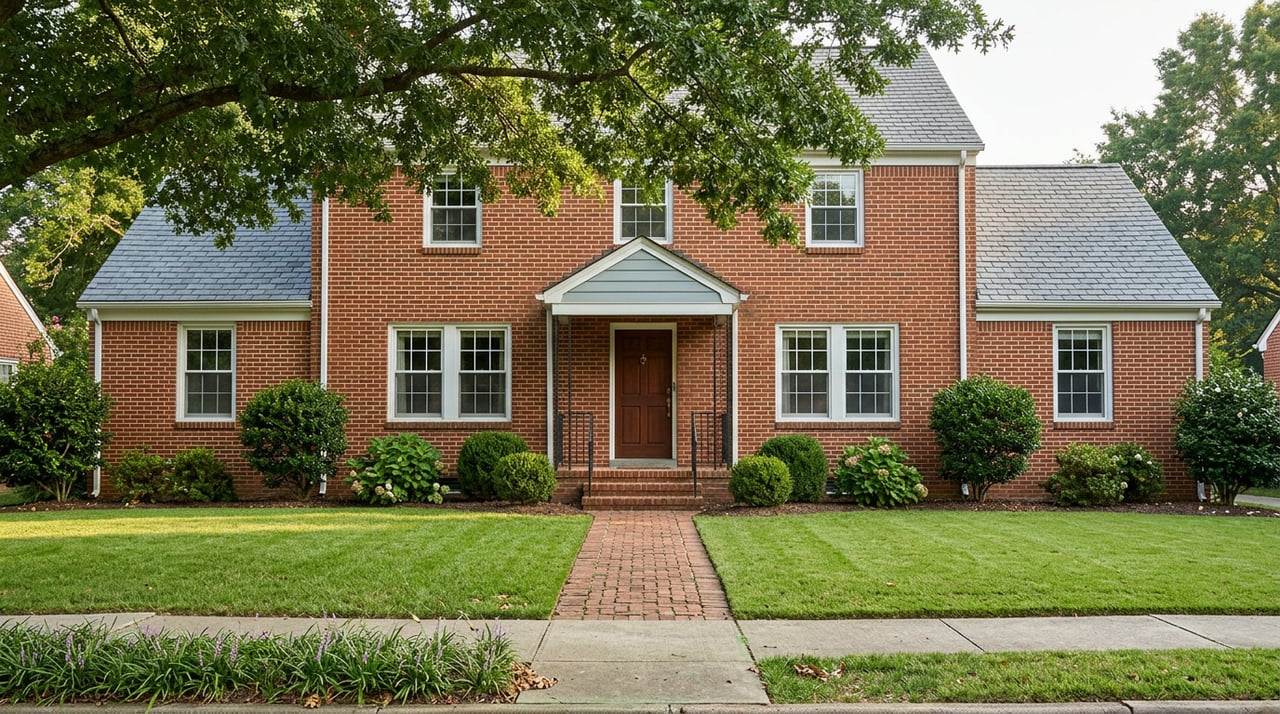
The median price for Larchmont and Edgewater sounds like a single, dependable number. It isn't. Pull it from one home-value tracker and you get just over $510,000. Check a different site the same week and it reads $534,000. A third puts it near $494,000. A fourth, built on a different valuation model entirely, lands closer to $590,000. None of these sources are wrong exactly. They're measuring slightly different things, at slightly different moments, using slightly different homes as the baseline.
That instability matters less for what it says about pricing algorithms and more for what it hides. If the most basic number in this market can't agree with itself from one source to the next, it was never going to tell you the thing that actually separates one Larchmont block from another: which side of an invisible mitigation line your future front porch sits on.
Right now, in this specific neighborhood, that line is real, physical, and mid-construction.
Two Streets, Two Very Different Timelines
Norfolk is not fixing Larchmont/Edgewater's flood exposure all at once. It's doing it block by block, on a schedule that has nothing to do with property values and everything to do with permitting, engineering, and which street floods worst first.
On Carroll Place, the work is done. The city raised an existing earthen berm from three feet to four, reinforced it with concrete blocks packed with dirt, topped it with Bermuda grass, and replanted marsh grass along the edge. Michael Crockett, president of the Larchmont-Edgewater Civic League, called it good news for a street that used to flood so often during moderate high tides that residents were effectively cut off from their own block.
"We're so excited about it," Crockett said of the completed berm, adding that the neighborhood has learned to live with the occasional clogged check valve. "This is just part of living in Norfolk, Virginia."
A short drive away, on Richmond and Surrey Crescent, the story is different. The city is moving ahead with a $7 million shoreline project that will replace an aging bulkhead on the Lafayette River, add a low-profile knee wall, restore a living shoreline, and install an oyster reef structure. As of this summer, the design is roughly 65 percent complete, with construction targeted for the summer of 2027 if permitting stays on schedule. Justin Shafer with Norfolk's Office of Resilience said preserving views of the river was a deliberate part of the design, so residents walking or driving the Crescents won't see an obstructed view once the wall goes in.
Crockett's read on the neighborhood's broader relationship with flooding was blunt: "Flooding is sadly our normal around here."
Here's the comparison that matters for anyone shopping this neighborhood right now:
| Carroll Place | Richmond & Surrey Crescent | |
|---|---|---|
| Status | Complete | ~65% through design |
| Method | Raised earthen berm, concrete block core, marsh grass | New bulkhead, knee wall, living shoreline, oyster reef |
| Cost | Smaller-scale city project | $7 million |
| Timeline | Finished | Construction targeted summer 2027, pending permits |
| Known friction | Check valves can clog and need city clearing | Design phase, not yet built |
A house near a finished berm and a house near a bulkhead still in the design phase are not carrying the same risk profile today, even if they're both technically in Larchmont, both built in the same decade, and both listed within a few thousand dollars of each other.
What a Class 5 Rating Actually Buys You
Norfolk participates in FEMA's Community Rating System, a voluntary program that rewards cities for floodplain management that goes beyond the federal minimum. Since April 2022, Norfolk has held a Class 5 rating, one of the better scores in the state. That translates into a real discount: up to 25 percent off National Flood Insurance Program premiums for policies inside the Special Flood Hazard Area, and 10 percent for policies outside it.
That's not a rounding error. On a policy running a few thousand dollars a year, a 25 percent discount is real money, every year, for as long as the rating holds and the policy stays compliant with local floodplain rules.
Here's the part that should change how you shop. Even with that citywide discount sitting on the table, only about 13 percent of households in Norfolk County actually carry flood insurance, according to flood-claims and policy data compiled as of March 2026. Norfolk's flood risk is well above average. Its NFIP participation is not. That gap between exposure and coverage means a meaningful share of the market, buyers and sellers alike, isn't factoring the Class 5 discount, the local mitigation schedule, or even basic flood insurance costs into how they think about a house until late in the process, sometimes not until underwriting flags it.
The Same Neighborhood, Three Different Quotes
The clearest evidence that this isn't uniform came from the listings themselves. One Larchmont home near the water advertised a flood insurance quote of $694 a year, with the listing noting the house "never gets flooded." Another, a few streets over on a lot described as waterfront, stated flatly that flood insurance was required, with no quoted figure attached. A third listing, for a home not directly on the water, noted flood insurance was not required at all.
Three homes. One neighborhood. Three completely different starting points for what a buyer should expect to pay every year to insure the place.
This is the piece the median price can't carry. A $510,000 median and a $590,000 median are both describing an average across a neighborhood where the actual cost of ownership, once you add insurance, splits wide depending on elevation, proximity to the river, and which side of the Carroll Place berm or the still-unbuilt Richmond Crescent bulkhead a given address falls on.
What to Actually Ask Before You Write an Offer
If you're comparing two Larchmont or Edgewater homes, the conversation that matters happens at the parcel level, not the neighborhood level.
- Does this specific address have an elevation certificate on file with the city? Norfolk maintains these through its Forerunner system, and a licensed surveyor's certificate is often what turns a rough flood-zone guess into an actual insurance number.
- What flood zone is this parcel in, specifically, not the neighborhood generally? Norfolk's most common designations are Zone AE, Zone VE, and Zone X, and VE carries added wave-action risk that AE doesn't.
- Is this block covered by a completed mitigation project like the Carroll Place berm, or is it waiting on something further out, like the Richmond and Surrey Crescent bulkhead still in design?
- Does the current flood insurance quote already reflect Norfolk's Class 5 CRS discount, or is that being applied separately at underwriting?
- If the home sits near a berm, ask about check valve maintenance. Crockett's civic league has direct experience with valves clogging and the city response time to clear them.
- For anything with a private dock, bulkhead, or shoreline access, ask who is responsible for its maintenance and whether any permits are outstanding for repair work.
None of these questions show up in a median price. All of them show up in a closing statement.
A Few Straight Answers
Does every home in Larchmont/Edgewater require flood insurance? No. Requirements depend on the specific flood zone the parcel sits in and whether the loan is federally backed. Some homes carry no requirement at all, others require it as a condition of the mortgage.
What's the real difference between a berm project and a bulkhead project? A berm, like the one completed on Carroll Place, raises and reinforces the land itself to hold back tidal water. A bulkhead, like the one planned for Richmond and Surrey Crescent, is a structural wall along the shoreline, often paired here with a living shoreline and oyster reef for added stabilization. Both reduce flood risk, but they're different tools applied to different street-level problems.
Does Norfolk's Class 5 rating apply automatically to a home's flood policy? The discount applies to NFIP policies in a participating community like Norfolk, but it only holds if the structure is compliant with local floodplain management rules. A property out of compliance can lose eligibility for the discount until the issue is resolved, which is one more reason to ask directly rather than assume.
The neighborhood's reputation for tree-lined streets and older homes with character is well earned. What's changing right now, street by street, is which of those homes sit behind finished flood protection and which are still waiting on a project that's 65 percent drawn but not yet built. That distinction is worth more to a buyer than any single median price, no matter which source it comes from.
If you're weighing a specific address in Larchmont or Edgewater and want help reading its actual flood history, mitigation status, and insurance picture before you write an offer, Christopher Castle can walk the block-level details with you and help you ask the right questions before you're locked into a contract.